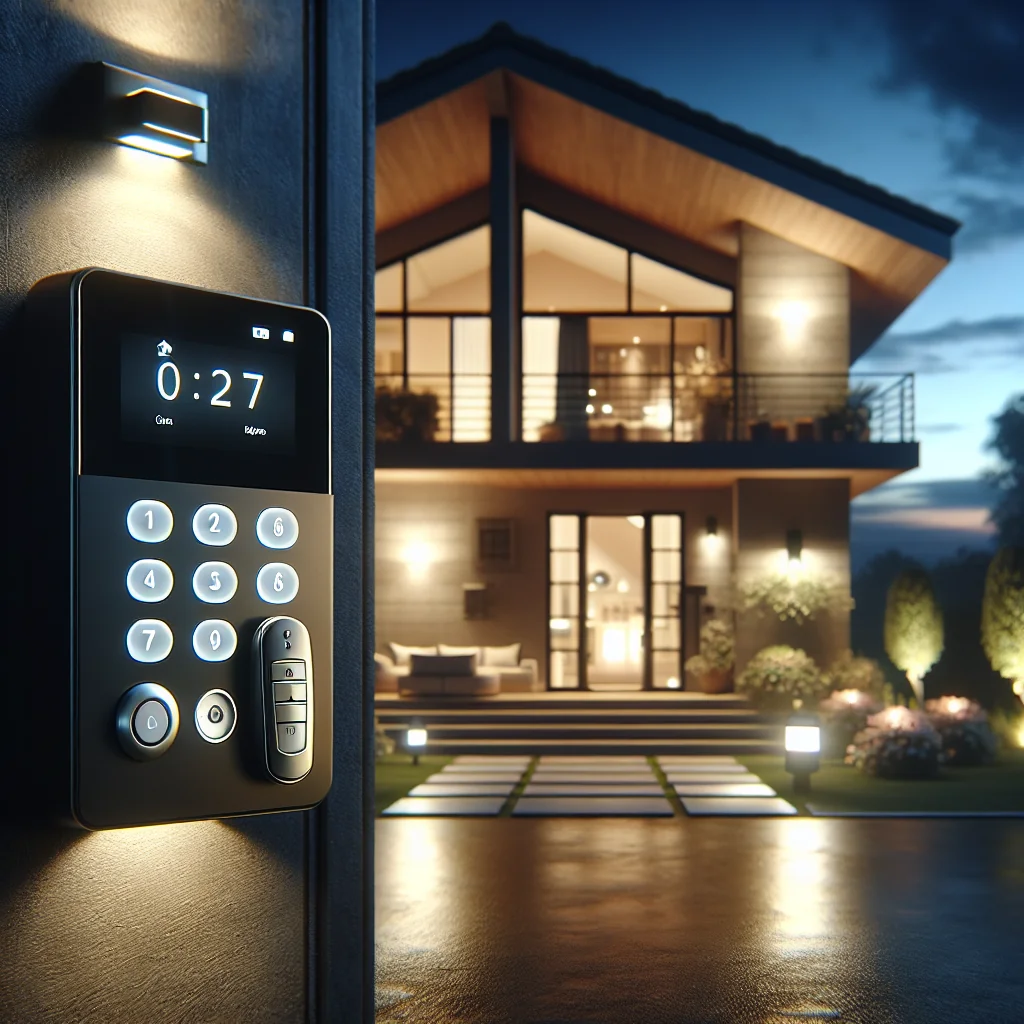

-Business Security Alarm System: Manual for Owners and Operators.
# Business Security Alarm System: A Practical Guide for Owners and Operators
You are responsible for the ⅼыlocking building, inventory, data, or personnel, and you know that a simple “lock the door and hope” is definitely insufficient. And, if you are looking at different options; the best way to begin is to open the site with a professional business security alarm system to give you a benchmark for your future “good” choice.
Asking questions that shake the ground is your insurer?
Experiencing a break,-in or a near miss could be another reason.
Or, you may have only realized that the “alarm system” you had was one camera, one siren, and a lot of positivity.
Occasionally, this will be the case as security alarm systems are life in disarray.
You encounter terms like EN, UL, Grade 3, and central stations, alongside hard-core cultivation pitches and many high-tech features that sound cool but do not address your essential question: *”Will this product save my business and that is it worth all my money?”*
The knowledge we’ve acquired while acting as security system specialists in various companies throughout both the US and Europe demonstrates clearly that the right architecture is often the sole way to avert troubles – nevertheless, we have also witnessed cases when the overbuilding is such a drawback that the design ends up being simply artistic.
The structure we have created is your guide to the topic. This will be helpful and will not complicate your understanding.
By the time you finish, you will have a clear idea of the requirements for a business security alarm system. Plus, you will have learned how to design a system that fits your risk and budget and the necessary features that vendors should supply so you do not pay for superfluous parts.
Moreover, you will learn the following:
- Why buying a cheap “all‑in‑one” alarm kit will only put you at greater risk
- The one setting mistake that causes most false alarms
- Ways to think about monitoring: self‑monitored, third‑party, or in‑house
- A simple 5‑step process to go from “we should improve security” to a working, tested system
Let’s design your alarm system in a way that it is simple to understand and believable.
—
## 1. What a Business Security Alarm System Actually Is (and Isn’t)
It is wise to determine what you are actually buying before you waste time comparing hardware or quotes.
A **business security alarm system** is a concept made up of interconnected devices as well as services that provide the following specific functions:
- Detects a threat (intrusion, forced entry, sometimes fire or environmental issues)
- Verifies it as real (ideally, not just a spider walking across a lens)
- Communicates it to someone who can act (you, a monitoring center, the police)
- Deters or delays the intruder (sirens, lighting, locks, shutters, etc.)
Hence, if any of these steps fail, the system fails too. It doesn’t matter how advanced your app is.
### Main components in simplified language
Prominent elements of hardware no matter the brand of the vendor have an architectural similarity to build most commercial systems.
– **Control panel** – The terminal device that connects all devices, stores, and sends alerts.
– **Detectors** – Various types of sensors including motion, remote door/window, glass-break, vibration, etc.
– **User interfaces** – Any identification devices that allow a user to operate the system (e.g. keypads, fobs, cards, mobile apps).
– **Signaling devices** – Integrated sound generators, flashing lights, and voice warnings.
– **Communication path** – Through cellular, IP, phone line, or a combination.
– **Monitoring** – Either you (self‑monitoring) or a professional alarm receiving center.
The picture that this understanding creates is that tangible outcomes will come with the decisions made right:
– Successful deterrence = Minor overall damage, decreased downtimes, and less insurer involvement.
– Fewer false alarms = Saved dollars (in some cities in the USA and abroad) and employees without alarm fatigue.
– Appropriate design = systems that help in your work instead of blocking it incessantly.
In fact, believing that “more devices = more secure” is a common fallacy.
Instead, *proper installation and integration* often outweigh the number of devices by far.
### Risk, grade, and monitoring summarized
To put it in simpler terms, here’s how risk, system grade, and monitoring usually align:
| Risk level | Typical business | System grade (EU example) | Monitoring approach |
|---|---|---|---|
| Low | Small office, low‑value equipment | Grade 1–2 | Self‑monitoring or basic third‑party |
| Medium | Retail store, standard warehouse | Grade 2–3 | Professional monitoring recommended |
| High | Jewelry, pharma, high‑value logistics | Grade 3+ | Professional monitoring with dual path |
You don’t need to be a standards expert, but you do need to know roughly where you sit on that spectrum.
—
## 2. Start with Risk, Not Hardware: Designing Around Your Real Exposure
The biggest mistake we see is buying equipment before you’ve mapped your risk. That’s how you end up With a beautifully protected reception area and a wide-open rear loading bay.
### Step 1: Identify what you’re actually protecting
Start with a simple inventory of what matters, not what looks impressive on a spec sheet.
List your critical assets:
– Physical: stock, cash, equipment, tools, vehicles
– Digital: servers, on-premise backups, network cabinets
– People: staff working late, lone workers, reception areas
Then map **where** they are and **when** they’re vulnerable.
A small office with laptops is one profile; a warehouse with high-value goods is another.
**Example (hypothetical):**
You run a small distribution warehouse. The highest-value items are in a cage at the back. Most break-ins will target that cage, not the reception coffee machine. That’s where your strongest detection and delay measures should be.
### Step 2: Understand your threat types
Different businesses face different patterns of risk, but most scenarios fall into a few buckets:
– After-hours break-ins
– Opportunistic theft during business hours
– Internal theft (staff or contractors)
– Vandalism or attempted entry that doesn’t fully succeed
Why this matters:
A system optimized only for after-hours intrusion may do nothing for daytime theft. You may need different modes (armed, partially armed, perimeter only, etc.) and different procedures for staff.
### Step 3: Check legal and insurance requirements
US and European regulations and insurance conditions can affect:
– Required **grade** of the system (e.g., EN 50131 Grade 2/3 in Europe for higher risk)
– Monitoring необходимые для определённых уровней рисков
– Police response rules (often only for verified or monitored alarms)
Before you make plans for your system, check:
– Your insurance policy wording
– Any local police / authority guidelines on alarms and false alarm policies
– Building codes or landlord requirements (especially in shared buildings)
Overlooking one could lead to the company’s schedule which will later turn out to be a waste.
-1
— 22-25
## 3. The 5‑Step Process to Build a Business Security Alarm System That Works
Once you understand your risks, you can move through a simple, repeatable process. Think of this as your project plan, not a one‑time brainstorm.
### Step 1: Define your protection zones
Break your site into zones, from outside in:
– **Outer perimeter** – Fences, gates, external doors, loading bays
– **Building shell** – Doors, windows, roof access, skylights
– **Internal critical areas** – Server rooms, stock cages, safes, cash offices
– **Common / low‑risk areas** – Corridors, open‑plan offices
Why it matters:
You don’t need the same level of detection everywhere. Over‑protecting low‑risk areas just creates false alarms and staff frustration.
Concrete actions:
– Mark zones on a simple floor plan (paper is fine)
– Label each zone with risk level: high / medium / low
– Decide what should trigger an alarm vs. just a logged event
### Step 2: Choose the right detectors for each zone
Each zone calls for a different mix of devices.
Typical options:
– **Door/window contacts** – Detect opening. Best for doors, main windows.
– **Motion (PIR or dual‑tech)** – Detect movement inside an area. Good for open spaces.
– **Glass‑break sensors** – Detect the sound/frequency of breaking glass.
– **Vibration / shock sensors** – Detect attempts to force doors, walls, safes.
What can go wrong:
– Poor placement (e.g., motion sensors facing windows or HVAC vents) = false alarms.
– Using only motion sensors on a high‑value perimeter = intruders already inside before detection.
Rule of thumb:
– Perimeter (doors/windows) = **contacts + glass/vibration** where relevant.
– Internal high‑value rooms = **motion + door contact**.
– Large open areas = **carefully placed motion**, possibly dual‑tech to reduce false alarms.
### Step 3: Decide on monitoring and response
This is where you decide who gets woken up at 3 a.m.—and under what conditions.
You have three broad options:
1. **Self‑monitoring** – Alerts go to your phone/app.
– Pros: Lower cost, more control.
– Cons: Relies on you being awake, available, and willing to drive in at odd hours.
2. **Professional monitoring (ARC / central station)**
– Pros: 24/7 operators, escalation procedures, often required for police response.
– Cons: Ongoing monthly cost, need to manage contact lists and protocols.
3. **Hybrid** – Some alerts to you, critical ones to a monitoring center.
For most businesses with physical stock or equipment, professional monitoring is worth close consideration. In many US cities and European jurisdictions, police will only respond automatically to alarms from certified monitoring centers or verified events.
### Step 4: Select communication paths
If your alarm can’t send a signal, it’s just a loud box on the wall.
Options:
– **IP (internet)** – Fast, cost‑effective, but depends on your network and router.
– **Cellular (4G/LTE)** – Independent of your main network; ideal as a backup.
– **Phone line (PSTN)** – Being phased out in many regions; increasingly unreliable.
Rule of thumb:
– At least **two communication paths** for higher‑risk sites (e.g., IP + cellular).
– Regular test signals to confirm connectivity and detect failures early.
### Step 5: Plan user access and everyday use
Systems fail when staff don’t know how to use them—or find them too annoying.
Decide:
– Who can arm/disarm (managers, keyholders, cleaning staff?)
– How they’ll do it (codes, fobs, cards, mobile app)
– How you’ll handle out‑of‑hours access and contractors
Common mistake:
Sharing one master code among everyone. This kills accountability and makes audits useless. Assign personal credentials so you can see who did what, when.
—
## 4. What Actually Moves the Needle on Security (Beyond Gadget Shopping)
Some factors have a disproportionate impact on how effective your business security alarm system is. They’re not glamorous, but they’re where the real risk reduction happens.
### Layered security, not single points of failure
Layered security means using multiple, overlapping measures so one failure doesn’t expose everything.
Impact: It increases the time and effort required for a successful intrusion—often enough to deter or disrupt.
Heuristic:
Aim for **at least two layers** protecting your highest‑value assets (e.g., perimeter + internal room alarm + mechanical lock). If one fails, the other still slows the intruder down.